Where Do Cruise Ships Dock in Tallin, Estonia
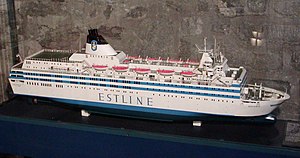 Scale mannikin of MS Estonia | |
| History | |
|---|---|
| Epithet |
|
| Owner |
|
| Operator |
|
| Port of registry |
|
| Ordered | 11 September 1979 |
| Builder | Meyer Werft, Papenburg, Cicily Isabel Fairfield Germany |
| Yard number | 590 |
| Arranged down | 18 October 1979 |
| Launched | 26 April 1980 |
| Acquired | 29 June 1980 |
| In service | 5 July 1980 |
| Recognition |
|
| Doom | Capsized and sank on 28 September 1994 |
| General characteristics | |
| Type | Cruiseferry |
| Tonnage |
|
| Length |
|
| Beam of light | 24.21 m (79 ft 5 in) |
| Draught | 5.60 m (18 ft 4 in) |
| Decks | 9 |
| Ice class | 1 A |
| Installed index |
|
| Speed | 21.1 knots (39.1 km/h; 24.3 miles per hour) |
| Capacity |
|
MS Estonia was a cruiseferry made-up in 1980 at the West German shipyard Meyer Werft in Papenburg. In 1993, she was sold to Nordström & Thulin for use on Estline's Tallinn–Stockholm route. The ship's sinking on 28 September 1994, in the Baltic Sea Suboceanic between Sweden, Åland, Finland and Estonia, was one of the worst maritime disasters of the 20th century, claiming 852 lives.
The official written report over that the bow room access had separated from the vessel, pulling the ramp open. The transport was already listing because of poor cargo distribution, and the listing inflated rapidly, overflowing the decks and the cabins. Shortly, power failed totally, inhibiting search and deliverance, and a full-scurf parking brake was non proclaimed for 90 minutes. Of the 989 happening panel, 138 were rescued. The report criticised the hands-off attitude of the work party, failing to notice that water system was entering the vehicle deck, delaying the alarm, and providing minimal guidance from the nosepiece.
Coordinates: 59°23′0″N 21°40′0″E / 59.38333°N 21.66667°E / 59.38333; 21.66667
Construction [edit]
The ship was originally ordered from Meyer Werft by a Norwegian transportation company LED by Parley Augustsen with well-meant traffic between Norway and FRG. At the last consequence, the company withdrew their order and the condense went to Rederi Ab Sally, one of the partners in the Viking Line consortium (SF Line, another partner in Viking Line, had also been concerned in the ship).[3]
Originally the send was conceived as a sister send off to Diana II, built in 1979 by the same shipyard for Rederi AB Slite, the third married person in Viking Line. When Sally took over the construction contract, the ship was elongated from the original length of approximately 137 metres (449 foot) to approximately 155 metres (509 ft) and the superstructure of the send on was largely redesigned.[3]
Meyer Werft had constructed a large number of ships for various Viking Line partner companies during the 1970s. The twist of the ship's bow consisted of an upwards-opening peak and a car Allium tricoccum that was placed inside the vizor when IT was closed. An identical bow construction had also been used in Princess of Wales II.[JAIC 1]
Service history [edit]
Republic of Estonia antecedently sailed as Viking Sally (1980–1990), Silja Star (1990–1991), and Wasa King (1991–1993).
Viking Line [redact]
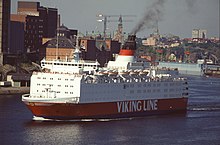
Along 29 June 1980, Viking Sortie was delivered to Rederi Ab Sally, Finland and was put into service on the route between Turku, Mariehamn and Stockholm[3] [4] (during summer 1982 on the Naantali–Maarianhamina–Kapellskär itinerary).[5] She was the largest ship to serve thereon itinerary at the time. As with umpteen ships, Viking Sally suffered some mishaps during her Viking Stemma service, being grounded in the Åland Archipelago in May 1984 and suffering several propeller problems in April of the following year. In 1985 she was also rebuilt with a "duck tail".[3] [4] In 1986, a passenger was murdered along board. In 1987, another murder and attempted murder took place. Rederi Ab Sally had been experiencing financial difficulties for most of the 1980s. In late 1987, Effoa and Johnson Stoc, the owners of Viking Line's main rivals Silja Line, bought Sally.[6] A a result of this, SF Line of business and Rederi AB Slite forced Wisecrack to withdraw from Viking Line.[3] [4] [6] Viking Sally was chartered to Rederi AB Slite to keep on on her incumbent traffic for the next three years.[3] [4] [6]
EffJohn [edit]
When her charter ended in April 1990, Viking Sally had an unusual exchange of Robert William Service. She was painted in Silja Line's colours, renamed Silja Star and situated on the same route that she had plied for Viking Line: Turku–Mariehamn–Stockholm.[3] [4] The reason for this was that Silja's new transport for Helsinki–Stockholm service was built slow schedule and one of the Turku–Stockholm ships, Wellamo, was transferred to that route until the late ship was ended in November 1990.[7] Also in 1990 Effoa, Johnson Line and Rederi Abdominal muscle Sally merged into EffJohn.
The following spring Silja Star began her service with Wasa Demarcation, another company owned aside EffJohn. Her name was changed to Wasa King and she served on routes connecting Vaasa, Finland to Umeå and Sundsvall in Kingdom of Sweden.[3] [4] It has been reported that the Wasa King was widely considered to be the uncomparable behaving ship in fringed brave out to have sailed from Vaasa.
Estline [redact]

Example of MS Estonia from Swedish Maritime Museum

Size comparison between the MS Estonia, a human, a car, a charabanc, and an Airbus A380
In January 1993, at the same fourth dimension when EffJohn decided to merge Wasa Line's operations into Silja Line, Wasa Baron was sold to Nordström & Thulin for expend along Estline's Tallinn–Stockholm traffic low-level the name Estonia. The existent ownership of the transport was rather complex, in consecrate for Nordström &adenylic acid; Thulin to get a loan to buy the ship. Although Nordström &A; Thulin was the company which bought the ship, her registered owner was Estline Transport Co Ltd, Nicosia, Cyprus, which chartered the ship to E.Liini A/S, Tallinn, Estonia (daughter company of Nordström & Thulin and ESCO), which in turn chartered the ship to Estline AB. As a result, the ship was actually enrolled in both Cyprus and Estonia.[3] [4]
As the largest Estonian-owned ship of the time, the Republic of Estonia symbolized the independence that Republic of Estonia regained later on the collapse of the Soviet Union.[8]
Decks and facilities [edit]

Plans of the decks 0 to 5, as the tank grace.

Plans of the decks 6 to 10.
The MS Estonia consisted of 11 decks, counting from the lowest (0) to the highest (10). Passenger facilities were located along decks 6, 5, 4, and 1, while the crew members occupied decks 8 and 7. Decks 2 and 3 were consecrated to consignment.
As Viking Sally [edit]
| 9 | Bridge, sundeck[9] |
| 8 | Crew cabins, sundeck[10] [9] |
| 7 | Crew cabins & facilities, sundeck[11] |
| 6 | Restaurant deck – Buffet dining room, à lanthanum carte restaurant, bar, open-air and inwardly cabins[12] |
| 5 | Entrance & cafeteria bedight – Untaxed shops, cafeteria, snack bar, discotheque, melodic line seats, children's playroom, outside and at heart cabins[9] [13] |
| 4 | Conference deck – League rooms, nightclub, cinema, inside and outside cabins[13] |
| 3 | Railroad car platform[14] |
| 2 | Elevator car deck[14] |
| 1 | Inside cabins,[12] railway locomotive room[11] |
| 0 | Sauna, horizontal syndicate, conference rooms[12] |
Sinking [edit]
| Nationalities | Deaths | Survivors | Sum |
|---|---|---|---|
 Sweden Sweden | 501 | 51 | 552 |
 Estonia Estonia | 285 | 62 | 347 |
 Latvia Latvia | 23 | 6 | 29 |
 Russia Russia | 11 | 4 | 15 |
 Finland Finland | 10 | 3 | 13 |
 Norge Norge | 6 | 3 | 9 |
 Germany Germany | 5 | 3 | 8 |
 Denmark Denmark | 5 | 1 | 6 |
 Lithuania Lithuania | 3 | 1 | 4 |
 Morocco Morocco | 2 | 0 | 2 |
 Netherlands Netherlands | 1 | 1 | 2 |
 Ukrayina Ukrayina | 1 | 1 | 2 |
 United Kingdom United Kingdom | 1 | 1 | 2 |
 Belarus Belarus | 1 | 0 | 1 |
 Canada Canada | 1 | 0 | 1 |
 Jacques Anatole Francois Thibault Jacques Anatole Francois Thibault | 1 | 0 | 1 |
 Nigeria Nigeria | 1 | 0 | 1 |
| Total | 852 | 137 | 989 |
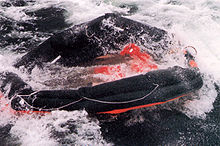
Peerless of Estonia 's inflatable life rafts, filled with water
The Estonia disaster occurred on Wednesday, 28 September 1994, between about 00:55 and 01:50 (UTC+2) as the send was crosswalk the Baltic, on the way from Tallinn, Estonia, to Stockholm, Kingdom of Sweden.[15] [16] Estonia departed slightly behind schedule at 19:15 on 27 September and had been foreseen in Stockholm the next morning at about 09:00. She was carrying 989 people: 803 passengers and 186 work party.[17] [JAIC 2] Virtually of the passengers were Scandinavian nation, although some were of Estonian origin, while most of the crew members were Estonian. The ship was fully ladened, and was listing slightly to starboard (to the right sounding from the ship in the focussing of its travel) because of poor cargo dispersion.[18] [19] There is a commemoration for the event in Tallinn.[20]
See also [edit]
- List of RORO vessel accidents
- List of accidents and disasters by death toll
- List of shipwrecks in 1994
- Sinking of the MS Estonia
References [edit]
- ^ "M/F Estonia". The ferry web site . Retrieved 21 October 2021.
- ^ a b Final report card on the capsizing on 28 September 1994 in the Baltic Sea of the Ro-Ro rider vessel Manganese Estonia, Chapter 3: The vessel. The Joint Chance event Investigation Commission of Estonia, Finland and Kingdom of Sweden, December 1997.
- ^ a b c d e f g h i "Wasa King" (in Swedish). Vasabåtarna.se. Retrieved 29 October 2007.
- ^ a b c d e f g "M/S Viking Sally" (in Swedish). Fakta om Fartyg. Retrieved 29 October 2007.
- ^ "Viking Sallying forth schedules 1980–1990" (in Finnish). FCBS Meeting place. Retrieved 29 October 2007.
- ^ a b c "Simplon Postcards: Viking Sally – Wasa King – Silja Star – Estonia". Retrieved 28 September 2014.
- ^ "MS Wellamo (1986)" (in Swedish). Fakta om Fartyg. Retrieved 29 Oct 2007.
- ^ "The Sinking of the Estonia." Surviving Calamity.[1] BBC. [ dead link ]
- ^ a b c "Viking Sally pack of cards plan". Viking Line pamphlet (in European nation, Scandinavian nation, and English). Vasabåtarna.southeastward. Retrieved 20 December 2008.
- ^ "General placement". www.estoniaferrydisaster.sack . Retrieved 21 June 2021.
- ^ a b "Viking Sally General System plan". Vasabåtarna.se. Retrieved 20 December 2008.
- ^ a b c "Viking Sally Restaurant deck 6 plan". Viking Course brochure (in Swedish and Finnish). Vasabåtarna.se. Retrieved 20 December 2008.
- ^ a b "Viking Sally League deck 4 plan". Viking Line leaflet (in Scandinavian country and Finnish). Vasabåtarna.se. Retrieved 20 Dec 2008.
- ^ a b "Viking Sally cutaway model". Viking Line brochure (in Swedish, Finnish, and English). Vasabåtarna.se. Retrieved 20 December 2008.
- ^ "Millivolt ESTONIA (Accident Investigation Perpetration (JAIC) Inalterable Report)". Onnettomuustutkintakeskus (in Kinyarwanda). 15 January 2021. Retrieved 21 October 2021.
- ^ "The ESTONIA accident 1994". SHK Statens Haverikommission (Swedish Accident Investigating Board) . Retrieved 21 October 2021.
- ^ Whittingham, The Blame Machine, p. 137
- ^ Whittingham, The Blame Machine, p. 138
- ^ "M/S Estonia emergency traffic". windytan.com/Estonia . Retrieved 21 October 2021.
- ^ "Memorial to the Estonia in Tallinn". Sites of Memory: Historical Markers, Memorials, Monuments, and Cemeteries . Retrieved 21 Oct 2021.
Generic [edit]
External links [delete]
- The Ferry Internet site: Images of MS Estonia (when information technology was named Viking Sally and Silja Star)
Where Do Cruise Ships Dock in Tallin, Estonia
Source: https://en.wikipedia.org/wiki/MS_Estonia
0 Response to "Where Do Cruise Ships Dock in Tallin, Estonia"
Post a Comment